Saloni Ramakrishna (September 2026)
BTRM Faculty Opinion
The Invisible Balance Sheet
How AI turns Climate information into financial decisions and Outcomes
Saloni P Ramakrishna
Climate risk is a defining financial risk of this century. And Yet for many banks, it sits in ESG/ Sustainability reports and regulatory disclosures, rarely moving into daily decisions that determine revenue, profitability, or shareholder value. Climate data is an asset that is invisible on the books, yet impacts the balance sheet as these data points have a hidden path to –
➢ Lending decisions
➢ Pricing
➢ Capital
➢ Liquidity
➢ Strategy …. and the list goes on.
The real problem is not so much lack of climate data, as much as it is of an unprecedented volume of “unconnected” information that is available to banks. The challenge really, is transforming these fragmented data points into timely , explainable, and financially relevant decision inputs.
The information problem of Climate Risk
Banks, possess a multitude of climate related data points. Individually they appear disconnected -as a sample:
➢ Customer’s carbon emissions disclosure
➢ A Flood Risk Map
➢ A supplier disruption alert
➢ A change in Energy policy
➢ A drought forecast in a certain geography
➢ Macroeconomic and market information
Seen independently, they are unconnected pieces of a puzzle. Every climate data source becomes exponentially more valuable when connected with the others. The connected continuum influences credit decisions, collateral values, liquidity planning, capital allocation and long-term profitability, net result of which show up in the balance sheet.
This is where a calibrated and well thought out Artificial Intelligence (AI) program becomes a force multiplier- not by replacing banking expertise, but by augmenting it manifold. The importance of an aligned AI program is not because it can predict Climate but because it can connect thousands of fragmented data points into signals that power decisions and help bank leadership shape business outcomes. AI compounds the value of climate information through its ability to identify relationships that conventional methods struggle to uncover at scale and speed required.
Climate Risk management is a symphony of invisible sets of notes played on different instruments:
Every department hears only its own instrument.
- Risk hears defaults
- Finance hears capital
- Treasury hears liquidity
- Business hears growth
- Compliance hears regulations
- Technology hears infrastructure
The board needs the complete symphony as it must connect its sustainability strategy to shareholder value, AI is the conductor of the orchestra, it needs to be well trained though!!
Banks that win are those that use the combination of climate information and “glass box” AI models to convert environmental risks into structured risk and financial intelligence. This drives portfolio balancing that finds new opportunities, protects and scales enterprise value.
The prize of AI Augmented Climate Risk and Finance Management – A Sample
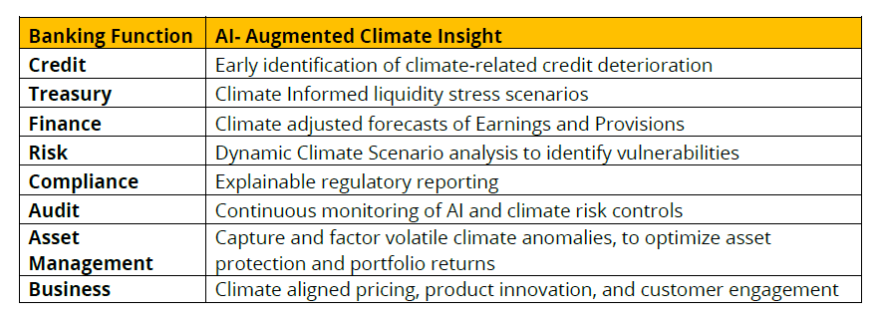
From compliance to competitive advantage:
Traditionally and historically banks responded to regulatory changes by building reporting processes. The emerging canvas and the opportunities it presents are different. The question has changed from asking “how do we comply with climate regulations” to “How can climate intelligence improve business decisions.” This important shift transforms climate risk from a cost centre into a strategic asset.
It is important to ensure an explainable transparent AI ecosystem. This matters because banking business is built on trust. This is why AI Governance is a critical AI Capability. For banks this means that “Black box” options are off the table. AI systems need to support transparent, auditable, and accountable decision making.
The ask for an interlinked capability.
Climate specialists understand climate science. Risk professionals understand financial risks and data scientists understand algorithms. It is rare to find professionals who understand all the three. Yet this intersection is where future competitive advantage will emerge. If a CXO asks what the financial value of the additional set of climate data points is, the answer can no longer be that “it is required for compliance reporting,” the answer needs to be that “they influence critical aspects of the bank” :
➢ Expected credit loss estimations.
➢ Loan pricing
➢ Collateral Valuation
➢ Portfolio concentration and its vulnerabilities
➢ Capital planning ….
Now it becomes apparent that a set of climate data points, affect thousands of dollars!! That is the multiplier of AI augmented climate risk management.
From Data to Dollars
Climate Data + “ Glass Box” AI Analytics = Risk Intelligence leading to business decisions that result in financial outcomes which determine competitive advantage and Enterprise Value.
These aspects are invisible in the financial statements. It resides in the quality of information, the speed of insight, and the confidence with which decisions are made delivering the desired outcomes. Important to remember that banks monetize refined intelligence not raw data. Banks that build an AI Augmented climate risk management ecosystem, will be able to navigate climate uncertainty, strengthen resilience, and create sustainable enterprise value. Bottomline – AI compounds the value of climate information manifold.
Financial value of climate information = Data x AI augmentation x Decision quality and speed*
* The last one, though not detailed in this article , is a value clincher.