Postgraduate Certificate in Commercial Banking (CCB)
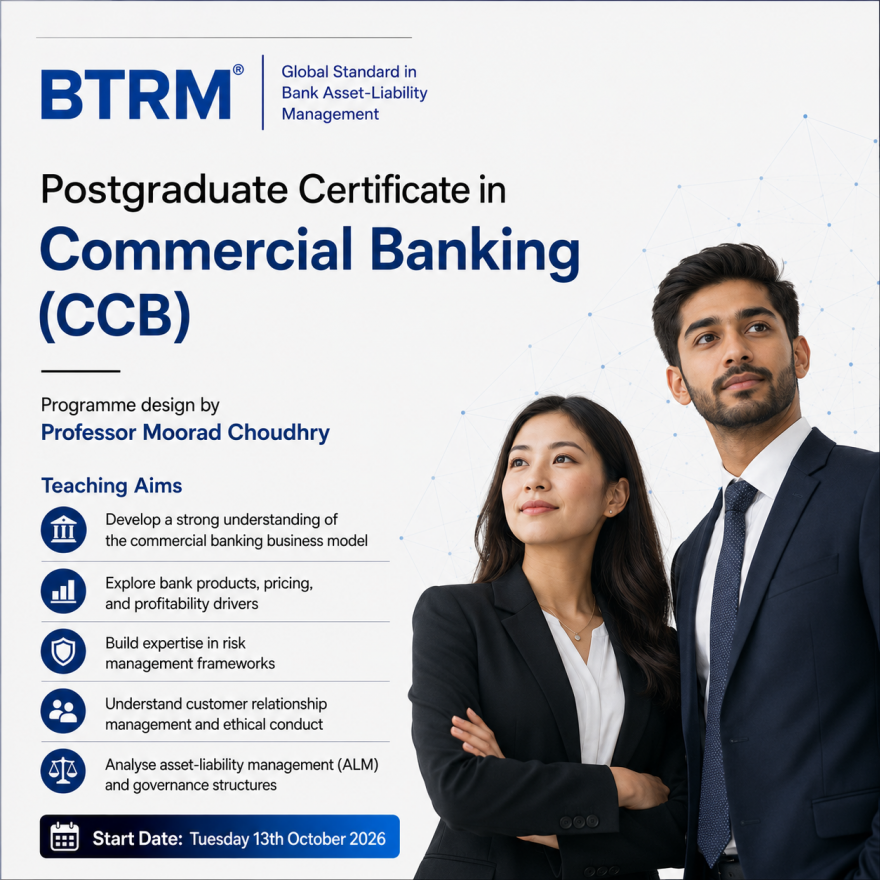 Programme design by Professor Moorad Choudhry
This is a 50-hour course (includes 32 hours of self-directed learning).
Develop a strong understanding of the commercial banking business model.
Programme Overview
The Postgraduate Certificate in Commercial Banking (CCB) is a postgraduate-level programme designed by Moorad Choudhry to provide a practitioner-focused understanding of commercial banking, covering the core principles, operational processes, and risk management practices used across the global banking industry.
Participants will develop both technical knowledge and practical insight into how banks operate, manage risk, and serve customers fairly within a regulated environment. The programme combines academic structure with applied industry learning, making it suitable for professionals seeking to strengthen their understanding of modern commercial banking.
Delivered by experienced practitioners from the BTRM Faculty, the CCB supports participants in building practical skills and professional capability relevant to today’s banking environment.
CCB Webinars:
- Recording now available: The Top 5 Priority Learning Challenges for Junior Bankers right now
-
Introducing The Postgraduate Certificate in Commercial Banking (CCB) – Tue, Sep 22, 6:30 PM UK
Teaching Aims
- Develop a strong understanding of the commercial banking business model
- Explore bank products, pricing, and profitability drivers
- Build expertise in risk management frameworks
- Understand customer relationship management and ethical conduct
- Analyse asset-liability management (ALM) and governance structures
- Start Date: Tuesday 13th October 2026
- Limited Availability: Enrol today
- Delivery Mode: Live Online & Recorded
- Flexible learning over 8 weeks
- 6 lectures (3 hours weekly) – Start time 17.30 UK
- Exam prep in the 7th week
- The examination will be sat in the 8th week of the course, on 1st December 2026.
- Structured Assessment: Final examination, Coursework & Certificate
- Core Text: Choudhry, M., The Principles of Banking, 2nd edition, Singapore: John Wiley & Sons 2012, 2023
(This title is designated the “Core Text” and will be supplied as an e-book to all students) - Total Learning Hours: 50 hours
- Instructors: BTRM Faculty
- Empowering Global Talent: Emerging Markets Subsidy
Course Faculty
- Professor Moorad Choudhry
- Professor Chris Westcott
- Malgorzata Tynecka
- Amit Bansal
 Download Event PDF