October 2026: More Inflation Ahead with Sticky Services, Tariffs and Iran; Less Anchored Inflation Expectations Means Higher Rates, a Late Fed and Credit Crossroads in 2027
October 2026: More Inflation Ahead with Sticky Services, Tariffs and Iran; Less Anchored Inflation Expectations Means Higher Rates, a Late Fed and Credit Crossroads in 2027
In my Sept column, I sketched out a coming macro fork in the road between elevated inflation with stagflation risk or recession. As we enter October, the macrofinancial landscape is growing even more complex. The intersection of persistent inflation, a resurging geopolitical crisis in the Middle East, more tariffs and some fiscal expansion from this Congress on the horizon appear likely to force US interest rates higher (yes, I am aware that the 10-year yield has declined of late).
For reasons I will discuss in this month’s column, inflation is too high; the Fed funds rate is too low, leaving long-dated Treasuries as the mechanism of interest rate adjustment. The problem with leaving the bond market to adjust where equilibrium rates should be is that long-dated Treasuries will tend to overshoot to the upside and embed a risk premium that is slow to recede.
Additionally, structurally higher global equilibrium interest rates post Covid imply a coming repricing of all assets — AI, housing, commercial real estate and equities – and associated decline in valuation and wealth that is beginning.[1]
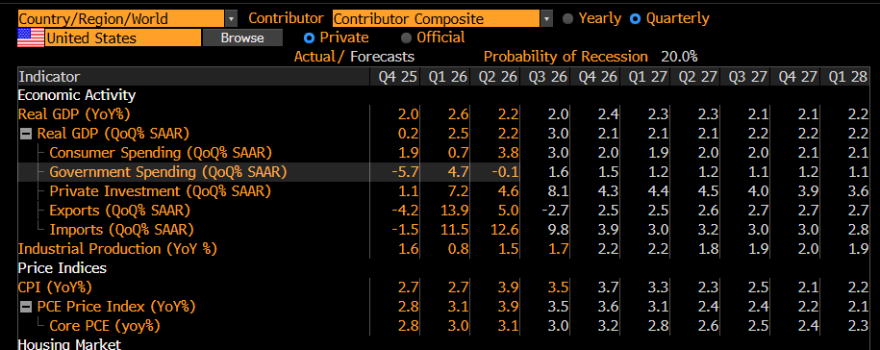
Let’s Start With Consensus 2027 US Inflation Forecasts
A new year is coming into view and the consensus sees US inflation starting to decline back towards target in the year ahead (table below). Let’s discuss why the consensus forecast for inflation once again seems unlikely to be realized.
Core Service Inflation: A Problem In Its Own Right
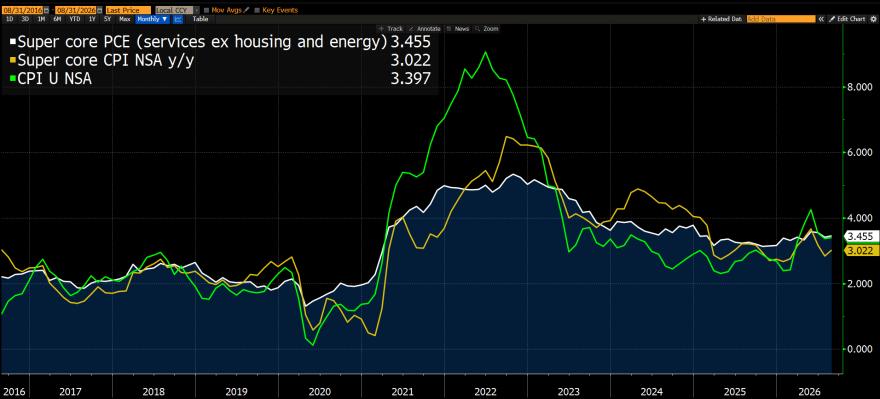
While there has been handwringing in some circles about the Fed raising rates, however, the US has a core service inflation problem.
Supercore service PCE (white) and CPI (green)—which excludes energy, food, and housing—remains persistently elevated. This metric has nothing to do with global commodities and everything to do with a structurally limited domestic labor supply due to changes in immigration policy and easy US financial conditions supporting consumption. Service-sector wage pressures and labor supply constraints continue to drive supercore inflation upward for the last three months as domestic price pressures were never fully tamed by the Federal Reserve’s prior tightening cycle.
Now Layer on Structurally Higher US Goods Inflation
As the chart below illustrates, pre-Covid core goods were a structural source of US disinflation. But Covid illuminated how globalization created geopolitical supply chain risks, particularly with China. In response, the Trump Administration introduced broad tariffs including on many consumer goods (shoes, coffee) as opposed to focusing tariffs more narrowly on national security and key industrial sectors, thereby generating unnecessary upward pressure on US goods inflation.
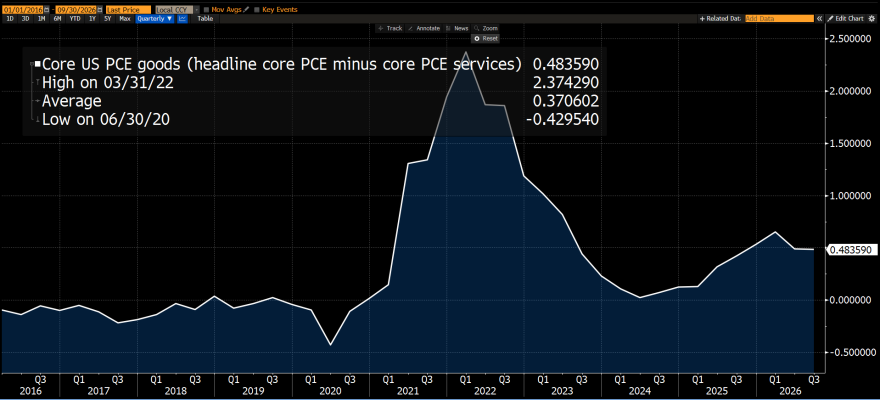
While I can understand tariffs if motivated by a national security/industrial base focus, the US trade deficit related to AI (computers, GPUs) has ballooned with many of these goods for the “strategic” US AI build out not subject to tariffs. While some tariffs can be argued as being rational economic policy for geo-strategic reasons, in my view the current tariff mix does not meet that criteria.
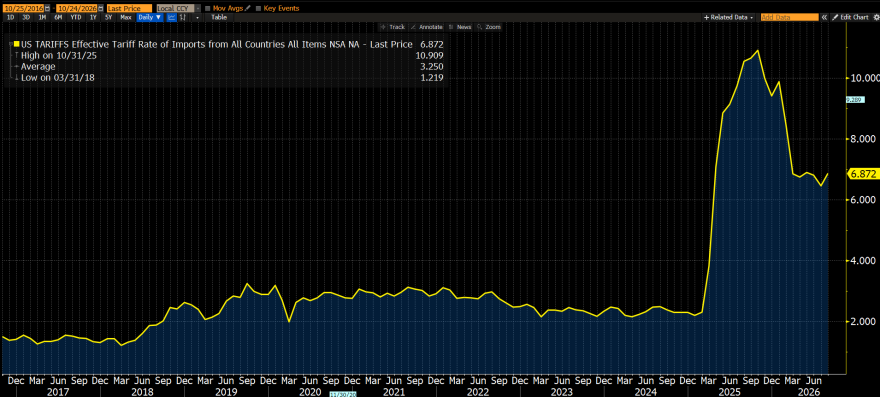
However, if prediction markets prove to be correct in their forecast that the mid-term elections flip Congress to Democratic control (90% House to Democrats, 67% Senate to Democrats), it seems plausible to expect that the White House could further utilize tariffs in 2027 (the US effective tariff rate currently sits at ~7%, yellow) as it is an economic tool that sits solely within executive branch control, keeping US good inflation elevated.
Geopolitical Escalation: The Iran War Poised to Resume
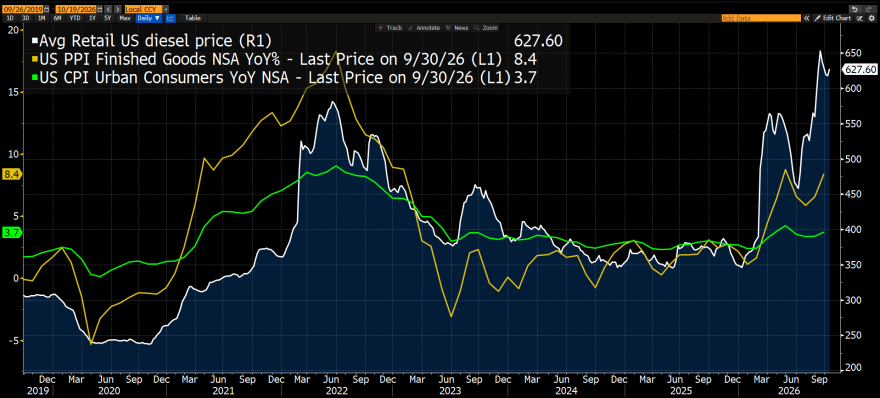
Compounding this structural 3%+ inflation problem is the reality that the war with Iran appears poised to resume. As I have written since the beginning of this conflict, the temporary relief of a ceasefire was never a durable resolution. The primary structural issue for the global economy remains whether key energy-producing assets in the region are physically damaged in a manner that locks in higher-for-longer (H4L) oil and refined product prices. It appears we are moving closer to that risk becoming a reality.
With the conflict in the Strait of Hormuz poised to resume alongside increasing hostilities in the Red Sea between the Houthis and Saudis and ongoing disruptions from the Russia-Ukraine war (while I support Ukraine I am skeptical that peace negotiations with Russia yield much progress), global supply chains remain under a severe chokehold. If military actions resume and target regional infrastructure, we will move past a temporary shipping disruption and straight into a permanent structural shift higher in global energy costs. As I have written about previously, the US being a “net exporter” of hydrocarbons does not shield the US from higher global oil and refined product prices and export bans do not work (check my Substack).
US Household Inflation Expectations Are Increasingly Unanchored
A risk that many within the FOMC appear to be underreacting to is the rise in US consumer inflation expectations which continue to shift up in response to tariff policy errors, ongoing negative supply shocks and inflation not being brought back under control. As I have written about previously, TIPS breakeven will send confusing signals to policymakers on inflation expectations if there is concern about a downward revision to CPI from forthcoming methodology changes.
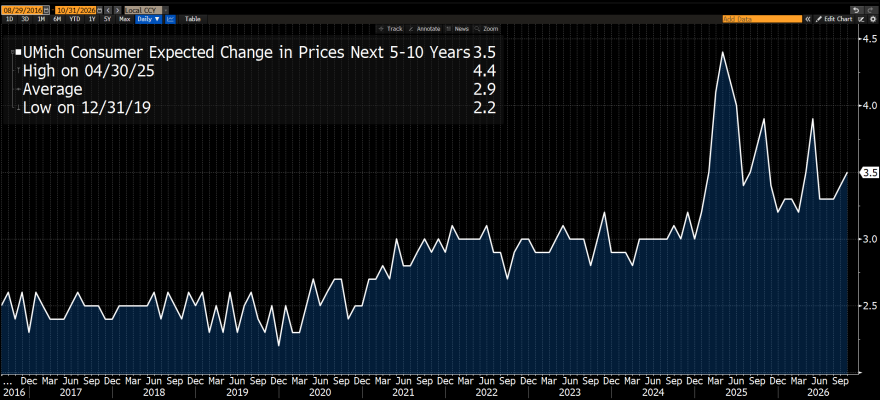
In an October note titled “Risks of Entrenchment: Long Run Inflation Expectations in Recent and Longer Historical Context,” the Director of University of Michigan’s Survey of Consumers, Dr. Hsu states (emphasis added):
Post-pandemic inflation expectations echo patterns seen in the initial inflationary episodes of the 1960s and 70s as consumers internalized higher inflation expectations over the course of a series of supply shocks. The adoption of inflationary psychology would lead consumers to shift purchases to the present to avoid higher prices in the future.
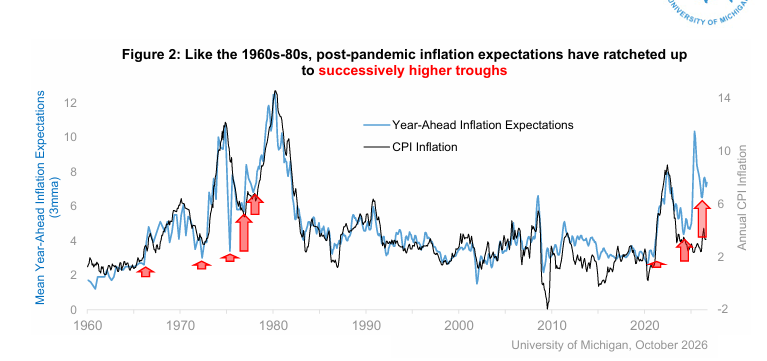
She notes further (emphasis added):
Multiple inflationary episodes in the 1960s to 1980s occurred amid a series of supply shocks: the closure of the Suez Canal in 1967, the 1973 oil embargo, and the 1978-1979 Iranian Revolution. During each of these inflationary episodes, inflation expectations surged then eventually ebbed with disinflation. Critically, each decline in expectations bottomed out before reaching the level seen prior to that episode (red arrows). With each successive inflationary episode, the trough in expectations was higher than the one prior; each successive escalation in inflation expectations began from a higher base than the episode prior and surged to a higher peak. These patterns likely set the stage for an entrenchment of elevated expectations and the proliferation of inflationary psychology that began gradually in the initial years of the Great Inflation, ratcheting up with each additional inflation shock. By the peak of the 1980s episode, consumers had already adjusted to about 15 years of repeated bouts of inflation, and extraordinary measures were required in the 1980s to bring down inflation in a lasting manner.
The fact that aggregate consumer spending has been relatively resilient despite negative views of the economy provides another reason for caution. If part of consumption currently reflects precautionary spending to avoid future price hikes, disinflation may be even more difficult to achieve.
Four key factors further skew 2027 US inflation risks to the upside:
- The 3.6% 2027 Social Security COLA: This adjustment based off of the most recent CPI data will inject a demand-side “echo” inflation shock into the economy in 2027, mirroring the post-Covid inflation dynamics.
- Risk of Further Tariff Usage: Given the anticipated change in Congressional control, the Administration is highly likely to rely once again on unilateral tariff policies to protect domestic industries, which will directly push import costs and consumer goods prices higher.
- Protracted Gulf Conflict: It is not evident how the war with Iran resolves but the timeline has proven much longer than markets have expected, contributing to elevated inflation and rising inflation expectations.
- Further US Government Spending: The potential flip in US House of Representatives control increases the prospect for further deficit spending in what is left of 2026. If they face a divided government in 2027, the current Congress in Q4 2026 may seek to pass a new budget package before the transition. Theoretically, one might anticipate that such a package could include passing legislation to raise the debt limit well ahead of the summer 2027 Treasury debt limit deadline and passing two spending bills late in Q4 to fund the Iran war and provide economic support to US farmers. How big will this fiscal package be? It is hard to say at this point. However, further US government spending may widen the budget deficit into an environment of already elevated inflation, also contributing to higher inflation than the Fed and markets may currently assume.
Repricing AI
The risks in the AI that were flagged back in my February and August columns have begun to manifest as the sector reprices.
We are seeing clear cracks forming in the AI narrative, driven by several compounding factors:
- Higher Interest Rates Increase AI Funding Costs: Higher rates increase the cost of new finance to fund the AI build out. For a firm like CoreWeave and Oracle, the increase in their bond yields makes needed incremental funding more challenging to repay. Rising interest rates also are increasing the discount factor and undermining stretched AI equity valuations and IPOs of OpenAI and Anthropic that were built on the assumption of cheap, long-term capital.
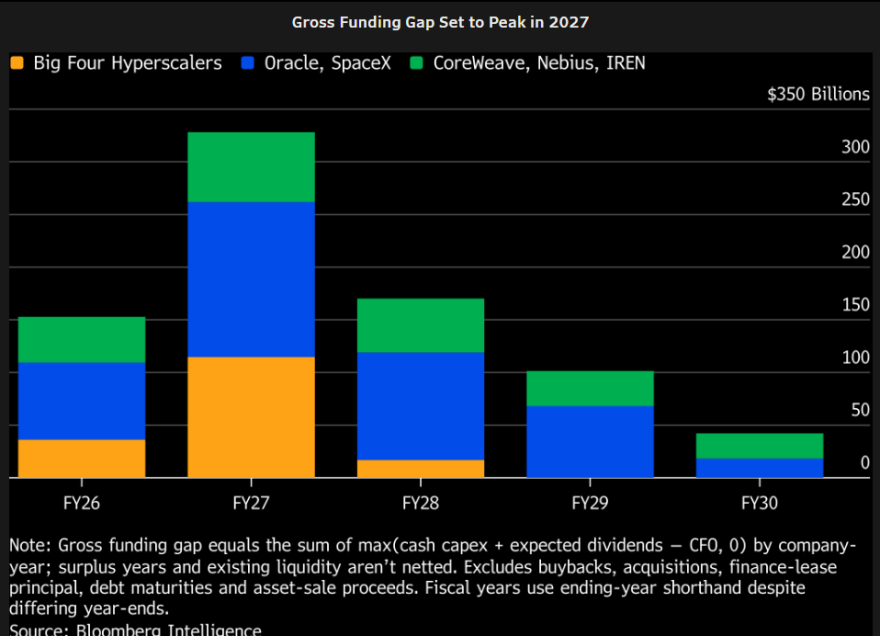
- Revenue Not Showing Up:
- Data Center Slowdowns: Public concerns over power grid strain, water usage, and local environmental impacts have led to notable data center development slowdowns which negatively impact AI firm’s cash generation.
- AI Not Contribution to Corporate Profits: A recent post from Apollo’s Torsten Slok illustrates quite starkly that AI has delivered little in terms of increased profitability or productivity to mainstream US companies outside of the technology sector. At the risk of stating the obvious, US companies are unlikely to pay for expensive compute if AI is not contributing meaningfully to improving their bottom lines.
- Collateral Values Not Independent: In thinking about AI collateral, I couldn’t help but reflect on an oil and gas lending analogy. In both oilfield services and AI data center lending, the fundamental flaw is the same: the collateral is not truly an independent source of repayment. Just as O&G equipment to support fracking is only worth millions when oil prices are high, an AI GPU is only worth millions when other businesses want the compute. Thus, both the borrower’s ability to pay and the lender’s collateral value can weaken at the same time.
- Off-Balance Sheet Liabilities: There is growing corporate bond market concern regarding the scale of convoluted off-balance sheet SPVs, guarantees, complex leases, off-take agreements and non-transparent securitizations. Having reviewed some hyperscaler bond deals and covenants with students this quarter, we observed significant gaps with regards to bondholder protections from SPVs, guarantees and subsidiary creditors. I discussed how the equity of hyperscalers is repricing lower to better reflect implied default probability of hyperscaler bonds and CDS
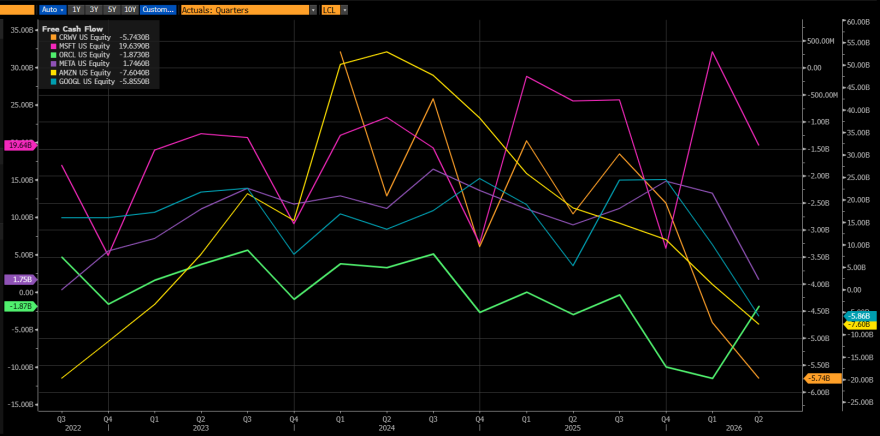
- Greater Investor Focus on Free Cash Flow vs. Reported Earnings: Accounting 101 teaches that the most important financial statement is a firm’s statement of cashflows due its reduced susceptibility of manipulation. Accordingly, AI credit investors are shifting their focus away from reported earnings at AI firms that rely on optimistic hardware depreciation assumptions and toward tangible, realized free cash flow.
Note the downward trend in CoreWeave’s free cashflow (orange), from +$0.3 billion in Q1 2024 to -$5.7 billion as of Q2 2026. A similar concerning downward trend is of note in Oracle’s free cashflow (green) — +$4.7 billion in Q3 2022 to -$11.5 billion in Q1 2026 before “bouncing back” to -$1.87 billion in Q2 2026.
Just as the US railroad bust of the 1870s and the dot-com crash of 2000 demonstrated, speculative capital-ex booms eventually face a violent day of reckoning when cash generation fails to meet investor expectations. It doesn’t mean that AI technology won’t be applied in transformative ways in the years ahead, but initial over-enthusiasm, malinvestment – in this case due to excessively accommodative US financial conditions — and overbuilding seems to be a persistent feature of major technological change.
Overly Accommodative/Easy US Financial Conditions and Significant Government Tax and Tariff Incentives Have Produced AI Malinvestment
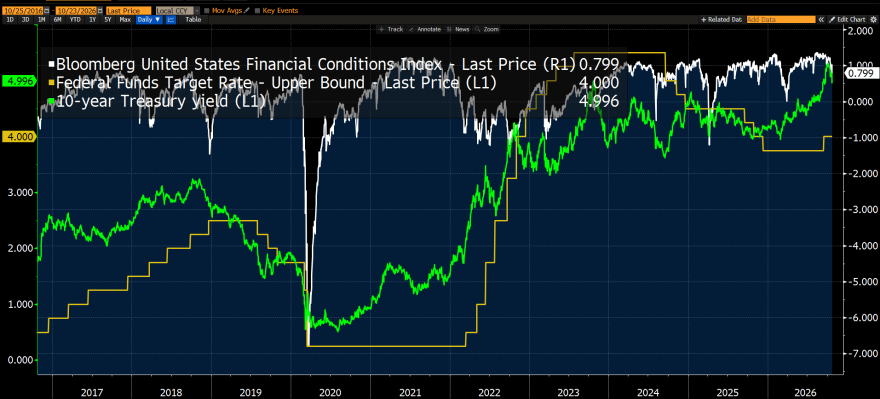
As I pointed out in a discussion on the WSJ’s podcast in August, US financial conditions still remain quite easy. While US financial conditions have tightened some since the Aug interview, aggregate US financial conditions (white) still are akin what was pre-Covid the upper bound of accommodative/easy.
The 10-year Treasury (green) is signaling to the Fed that its policy is not restrictive. Indeed, how could Fed policy be restrictive with the lower bound of the Fed funds target range equivalent to headline US inflation/short-term US interest real rates not being positive?
A continuing AI boom implies ongoing easy credit, some projects that do not make long-run economic sense and continued above target inflation. Long-dated yields have lost patience with continued inflation. The bond market will curb some of the malinvestment associated with the AI boom if the Fed lacks the will to. Some investors may believe that a US government bailout for CoreWeave and others will come due to “national security” reasons. Perhaps, but such an action would require Congressional support and could face an uphill battle after the mid-terms.
What Is Ahead: Oct FOMC and Nov Treasury Quarterly Refunding
Unfortunately, I am revising my outlook for this week’s Oct FOMC relative to my Sept column.
I now expect the Fed to keep rates unchanged. Since the Sept FOMC meeting comments from FRBNY President Williams and Vice Chair Jefferson have caused the market to largely price out an Oct Fed rate hike which seems to have been the policy intent of FOMC leadership, including Warsh. Chair Warsh’s fireside chat at the IMF/WB meetings also was largely devoid of meaningful content on the US economic outlook to suggest more tightening at the Oct meeting.
Therefore, I expect this week’s Fed meeting to be an unfortunate replay of July FOMC with regional presidents seeking to raise rates by 25 bps, but getting outvoted by the Governors. [2]
So while the Sept FOMC meeting was a notable improvement for Chair Warsh, it appears that we may regress at this week’s Oct FOMC meeting. The risk here is that — like July FOMC — long-dated Treasuries sell off after the announcement.
However, this Fed meeting also coincides with the Treasury’s Quarterly Refunding. Perhaps Secretary Bessent hopes to mute a long-end selloff through rumors of potential cuts to long-dated Treasury issuance at his Quarterly Refunding announcement on Nov 4th if the FOMC holds this meeting?
In recent months, the Treasury Dept repeatedly has sought to ease US financial conditions through shortening its weighted average maturity (WAM) and conducting long-end buybacks. Cuts to long-dated issuance at the upcoming Treasury Quarterly Refunding would be consistent with Bessent’s prior interventions. However, Treasury seeking to lower long-term interest rates works at cross purposes with the Fed on tightening financial conditions and bringing inflation back to target.
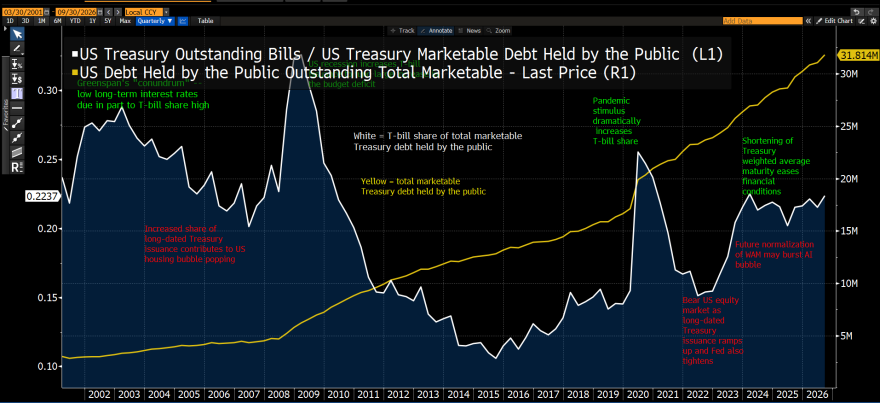
So, will we get an outcome again where US financial conditions move in a manner that is inconsistent with the Fed’s decision? Treasury’s bond market interventions have had limited effect so far so, on balance, I think a Fed hold at Oct FOMC results in higher long-dated Treasury yields.
2027 Credit Events: Limited Credit Events or Broad Credit Stress?
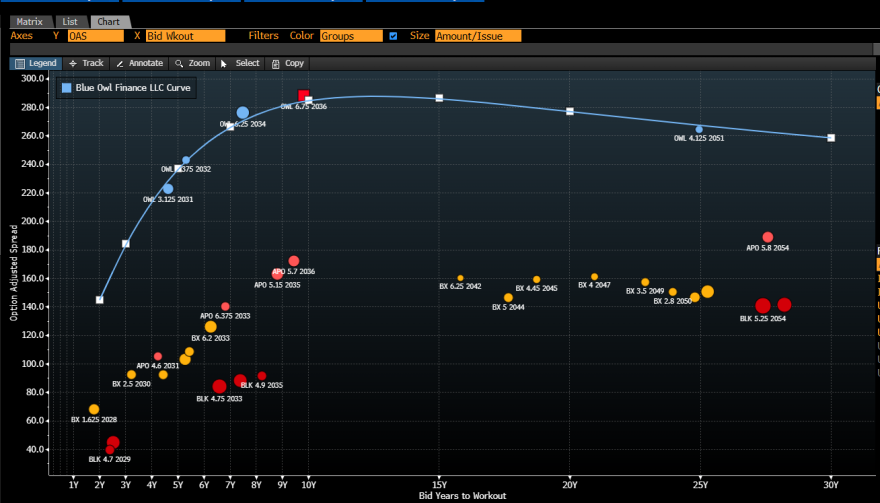
With inflation staying higher for longer, inflation expectations less anchored and the Fed likely late to tighten, it is highly plausible that we will witness credit events for weaker AI players in 2027. These entities, squeezed by escalating debt service costs, weaker revenue and failing to generate sufficient free cash flow, may find their access to capital markets abruptly shut. As I discussed in prior columns, AI credit spillovers to weaker private credit firms (like BlueOwl) also seem increasingly plausible/likely.
Fed rate hikes in 2022 and 2023 produced idiosyncratic credit events like SVB, Signature and First Republic, but these developments did not become broad-based credit stress.
Rather, a massive expansion in the US budget deficit in 2023 put “foam on the runway,” preventing credit losses from arising due to significant increases in the Fed funds rate.
It is less obvious that the Treasury market will easily accommodate such a large deficit expansion again in 2027 to offset Fed tightening and/or energy price shocks. Therefore, the risk of broader credit stress materializing as opposed to “just” idiosyncratic stress are higher than 2022-2023.
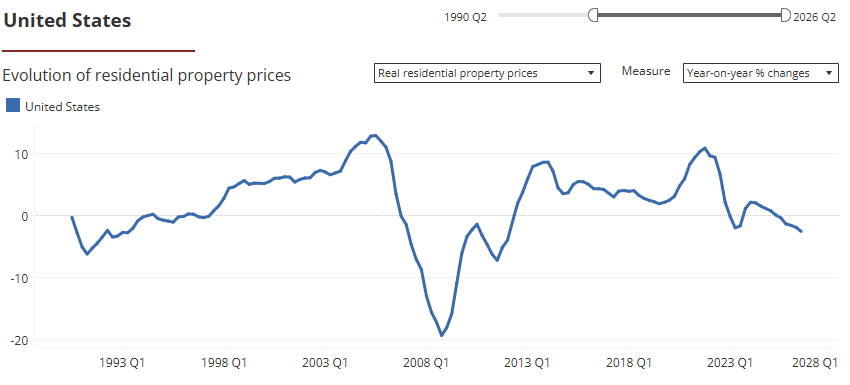
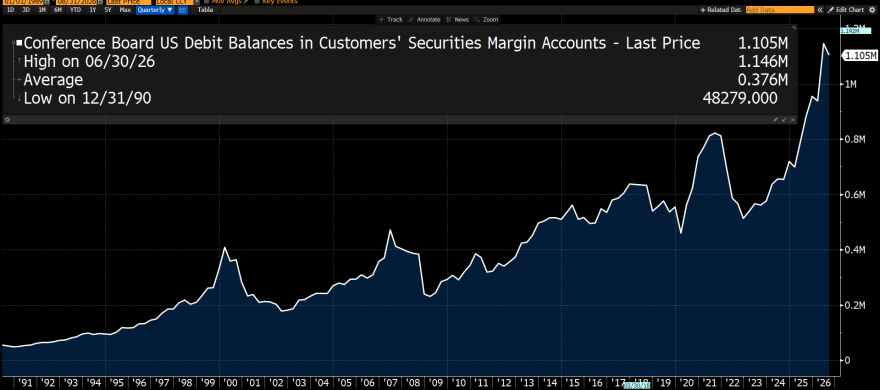
Many things could go bump in the night/break if the Fed gets too far behind the curve on inflation and must play catch up or if the bond market tightens policy on the Fed’s behalf, including US housing where valuations already are declining in real terms or retail investors’ record retail margin debt (look at what happened to South Korean retail investors with margin debt).
 What This Means for Banks
- Rigorously Stress-Test for Stagflation: Run scenarios where interest rates remain structurally elevated due to H4L inflation, while credit quality simultaneously degrades across both corporate and commercial real estate portfolios. A 6%+ 10-year Treasury yield is a risk scenario given upside risks to inflation.
- Review Counterparty and Leverage Limits: Do not wait for a high-profile fund failure to tighten prime brokerage and credit limits. Prune exposures to highly leveraged, semi-liquid private credit and AI-adjacent vehicles.
- Consider the Fracking Lesson: Credit risk officers must rigorously review bank exposures for ‘wrong-way collateral risk’—where both the borrower’s cash flow and the underlying collateral value (e.g., GPU chips or specialized tech leases) are highly correlated and could decline simultaneously.
- Build On-Balance-Sheet Liquidity: Ensure your bank holds high-quality liquid assets (HQLA) that are unencumbered and truly accessible. Avoid relying on defensive, short-term central bank facilities/discount window as part of your primary liquidity strategy. Leave discount window utilization for your contingent funding plan, not as part of your LCR (as some trade lobbies propose). As global dollar demand intensifies, deposit beta and decay may change significantly. It is key to actively monitor and manage deposit betas and secure stable, non-wholesale funding before the liquidity runway shrinks further.
- Focus Managing NII and EVE tradeoffs: Do not ignore EVE. As US bank supervision remains reliant on subjective “escalation reports” rather than quantitative standards for interest rate risk, safety is entirely the responsibility of bank management and boards. With upside risks to inflation and long-term Treasury yields, treasurers must address the ‘HTM trap’—where low-yielding, unhedged long-duration assets both erode capital strength and drag down ROA. Convene more frequent ALCOs, stress-test extreme rate-steepening tails, and evaluate active hedging strategies.
My sincere thanks to Treasury Talk readers. I hope some of these reflections on the outlook are helpful.
I hope you join us on Thursday Oct 29 for our virtual BTRM fireside chat webinar with former Kansas City Fed President Esther George on October FOMC takeaways and the US banking outlook – you can register here.
I also look forward to visiting with banking friends in Mexico in early November to speak at Mexican Bankers Association’s financial stability conference and Banorte’s roundtable on the macrofinancial outlook and what it means for bank treasury.
Finally, Moorad and I will discuss the US macrofinancial and banking outlook on a BTRM webinar on November 19 – registration is here.
Jill Cetina, CFA is Executive Professor of Finance at the Mays Business School, Texas A&M University, BTRM North America director, a former Associate Managing Director for US banks at Moody’s, former Federal Reserve officer and former financial economist at the OCC. The views expressed here are her own.
[1] In the first lecture of my bond course, I tell students that even if they do not plan to trade bonds, they should care about fixed income because rates are the discount factor for every asset in the economy.
[2] Cleveland Fed President Hammack has done a great job trying to rally the FOMC to begin to tighten. However, both she and Dallas Fed President Logan who has also spoken out about the need to bring inflation back to target will rotate off the Committee as voting members in 2027.